

Shein and Temu: Rethinking Global Marketing
Table of Contents
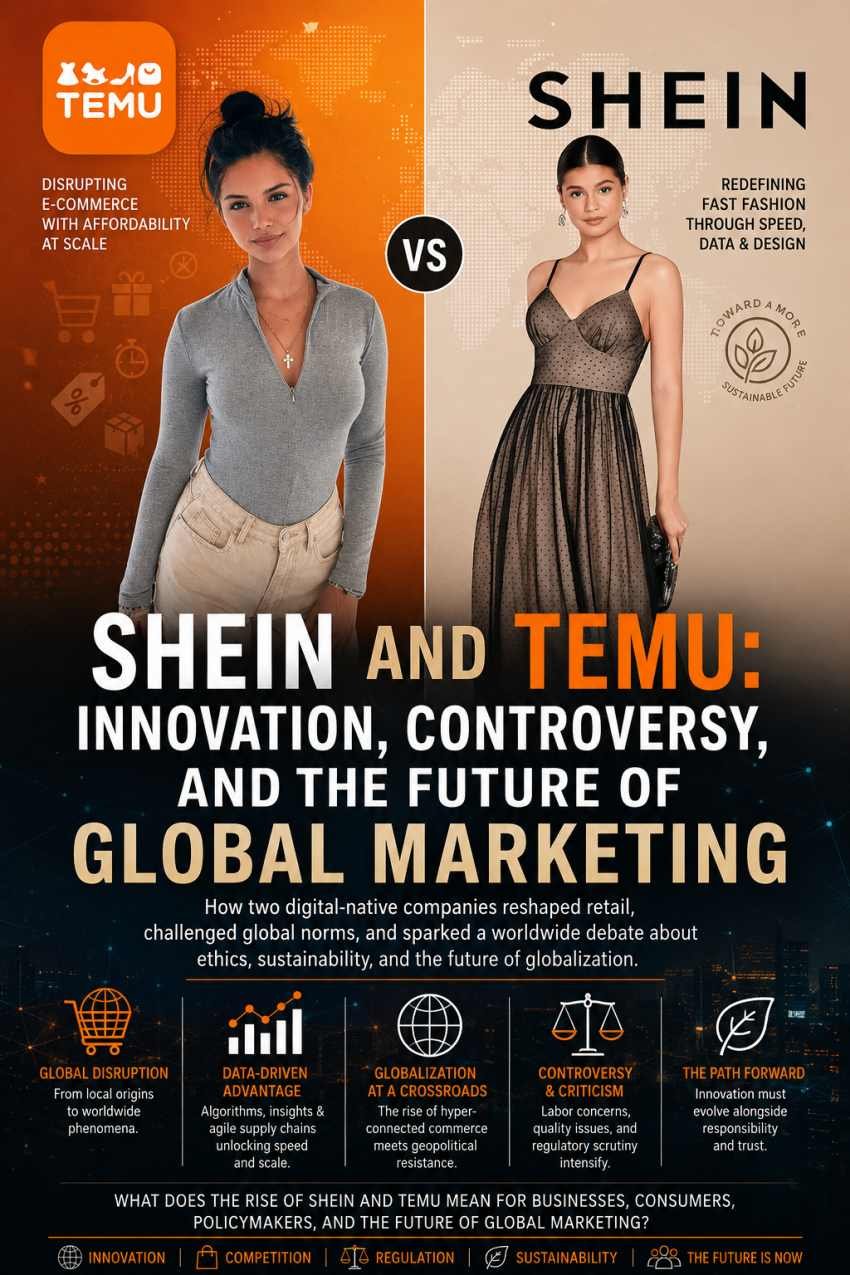
Shein and Temu: Innovation, Controversy, and the Future of Global Marketing
What Their Rise Reveals About Globalization, Internationalization, and Competitive Strategy
For decades, globalization was largely viewed as an inevitable force. Products could be designed in one country, manufactured in another, marketed through global digital platforms, and delivered to consumers worldwide. Few companies illustrate this phenomenon more dramatically than Shein and Temu.
Within a remarkably short period, these firms transformed global retail. Shein became one of the world’s most influential fashion platforms, while Temu rapidly emerged as a major force in e-commerce. Their growth has been so disruptive that governments, regulators, competitors, scholars, and consumers continue to debate their impact on markets and society.
Yet the central question may not be whether Shein and Temu are good or bad. A more meaningful question is why they succeeded when many established retailers with far greater resources struggled to achieve comparable growth.
From a global marketing perspective, the Shein-Temu phenomenon provides a valuable opportunity to examine the intersection of globalization, digital transformation, competitive advantage, institutional legitimacy, and internationalization strategy.
Why Shein and Temu Matter Beyond Retail
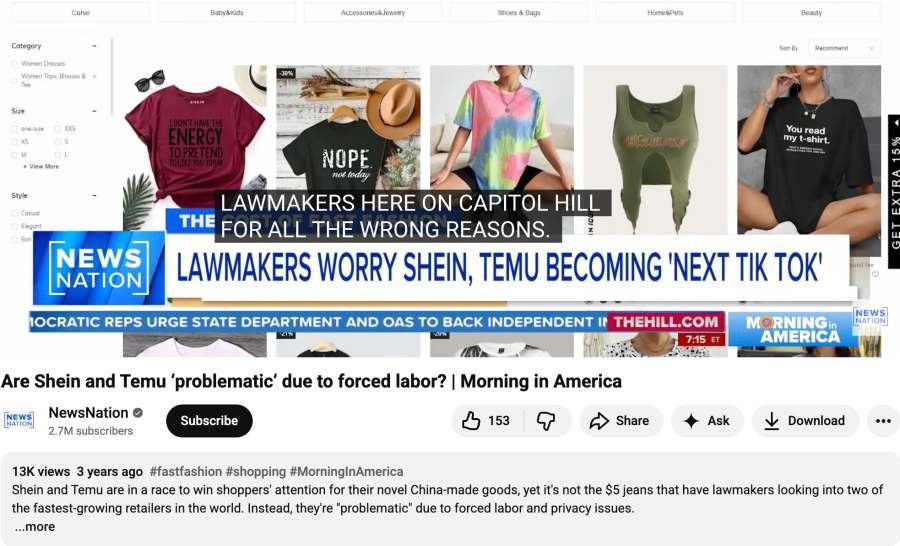
Most public discussions focus on controversies surrounding labor practices, sustainability, product quality, and regulatory scrutiny. While these issues deserve serious attention, they do not fully explain why Shein and Temu became global phenomena.
Millions of consumers did not adopt these platforms because of political ideology or trade policy. They adopted them because the companies solved fundamental consumer problems.
Consumers increasingly demand:
- Lower prices
- Greater product variety
- Faster access to trends
- Personalized shopping experiences
- Seamless digital purchasing
Shein and Temu delivered these benefits at a scale that many traditional retailers struggled to match.
According to Harvard Business School, the success of both companies stems largely from their ability to connect consumer demand directly to highly responsive manufacturing ecosystems, dramatically reducing inefficiencies present in traditional retail models (Harvard Business School, 2024).
This observation challenges a common misconception that their success can be explained simply by low-cost labor. Many firms have access to similar manufacturing networks. Far fewer have successfully integrated consumer data, supply chain responsiveness, digital marketing, and platform economics into a coherent global strategy.
The Emergence of a New Internationalization Model
One of the most intriguing implications of the Shein and Temu story is its challenge to traditional internationalization theory.
The Uppsala Internationalization Model developed by Johanson and Vahlne (2009) suggests that firms typically expand internationally in stages. Companies first develop experience in domestic markets before gradually increasing their commitment to foreign markets through exports, partnerships, and eventually direct investment.
Shein and Temu largely bypassed this process.
Rather than expanding country by country, they leveraged digital platforms to achieve rapid global reach. Their business models demonstrate how digital technologies can reduce traditional barriers to internationalization and accelerate global expansion.
For doctoral students, this raises a provocative question:
Does the digital economy require a fundamental revision of internationalization theory?
If companies can establish global presence through digital platforms before developing extensive physical operations, then many assumptions underlying traditional international business models may require reconsideration.
Shein and Temu | Their Greatest Competitive Advantage Is Not Cost
Public discourse often attributes the success of Shein and Temu to low production costs. While cost efficiency undoubtedly contributes to their competitiveness, this explanation is incomplete.
Michael Porter’s Competitive Advantage framework suggests that sustainable success depends not merely on lower costs but on unique capabilities that competitors find difficult to replicate.
In the case of Shein, these capabilities include:
- Real-time trend identification
- Data-driven product development
- Small-batch manufacturing
- Rapid product testing
- Highly flexible supplier networks
Temu’s competitive advantages include:
- Platform economics
- Marketplace scalability
- Algorithm-driven pricing
- Customer acquisition systems
- Network effects generated by thousands of sellers
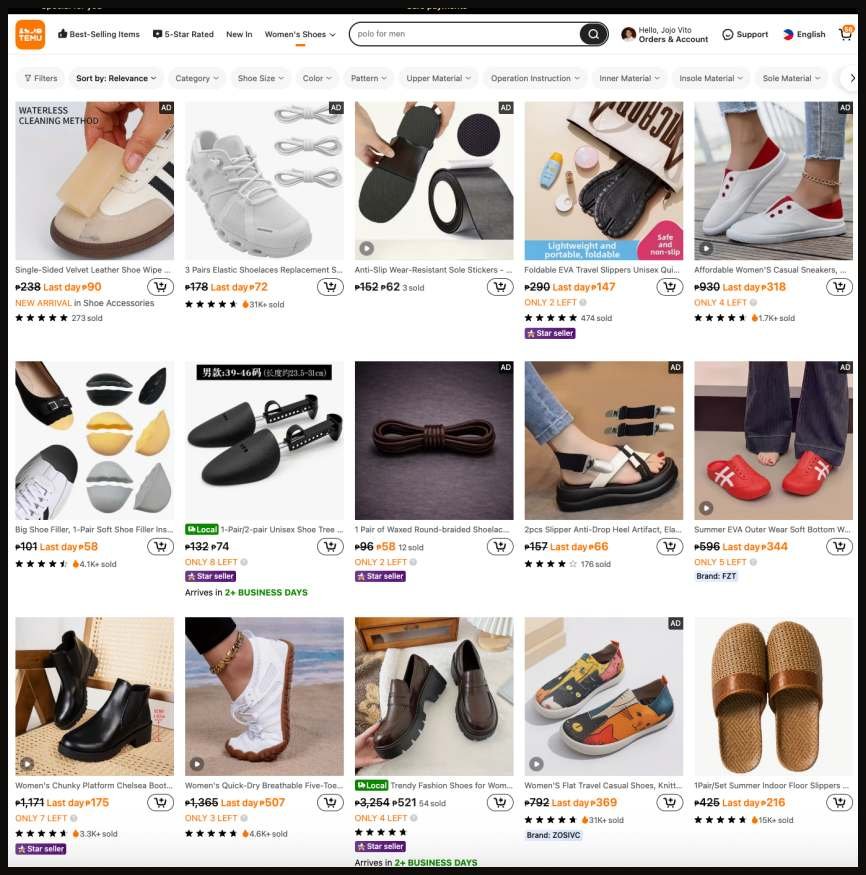
Viewed through the Resource-Based View of the firm, the most valuable assets possessed by these companies are not factories or inventory. Rather, they are data, algorithms, supplier relationships, platform infrastructure, and organizational capabilities.
This distinction matters because competitors cannot easily replicate such resources.

Why Competitors Are Concerned about Shein and Temu
The response of incumbent firms provides another indication of the significance of Shein and Temu.
Reuters, Financial Times, Bloomberg, CNBC, and The Wall Street Journal have documented how traditional retailers increasingly view these firms as major competitive threats. Companies such as Amazon, Walmart, Target, H&M, and Zara have all adjusted aspects of their strategies in response to changing consumer expectations shaped by low-cost digital platforms.
This reaction is consistent with Schumpeter’s concept of creative destruction. Disruptive firms frequently challenge established business models, forcing incumbents to adapt or risk decline.
Consequently, some resistance toward Shein and Temu may reflect not only concerns regarding ethics or regulation but also broader competitive dynamics.
This does not invalidate criticism. Rather, it suggests that economic interests and public-interest concerns may coexist.
The Globalization–Deglobalization Paradox
Perhaps the most important lesson from the Shein and Temu phenomenon is that it highlights the growing tension between globalization and deglobalization.
On one hand, these companies embody the logic of globalization:
- Global sourcing
- Cross-border logistics
- International consumer markets
- Digital commerce
- Platform-based ecosystems
On the other hand, their growth has intensified calls for:
- Greater regulatory oversight
- Import restrictions
- Enhanced customs enforcement
- Supply chain transparency
- National industrial policies
The International Monetary Fund has noted that trade fragmentation and geopolitical tensions increasingly influence international business decisions. In this context, Shein and Temu have become symbols of broader debates regarding economic integration and national competitiveness.
The controversy surrounding these companies therefore extends beyond retail.
It reflects a larger question:
How much globalization are governments willing to accept in an era of rising geopolitical competition?
Are Shein and Temu Being Judged by Different Standards?
This question is controversial, but it deserves scholarly consideration.
Many criticisms directed at Shein—including concerns regarding sustainability, labor practices, and overconsumption—have also been directed at traditional fast-fashion companies for years.
Harvard Business Review has argued that some criticisms associated with Shein reflect structural problems within the broader fashion industry rather than issues unique to a single company.
Similarly, marketplace concerns involving product quality and seller oversight are not exclusive to Temu. Comparable challenges have affected numerous digital platforms worldwide.
This observation does not absolve either company of responsibility.
However, it raises an important discussion point:
Are Shein and Temu uniquely problematic, or are they highly visible examples of broader industry challenges?
For doctoral students, this distinction is significant because it encourages critical analysis rather than simplistic conclusions.
Where They May Have Gone Wrong | Shein and Temu
Despite their remarkable success, both companies appear to have underestimated the importance of institutional legitimacy.
Institutional Theory suggests that organizations must satisfy not only customers but also regulators, governments, investors, advocacy groups, and society more broadly.
Shein’s rapid growth frequently outpaced its efforts to build trust among policymakers and stakeholders.
Temu’s aggressive expansion strategy similarly generated questions regarding quality assurance, compliance, and marketplace governance.
In both cases, operational excellence may have developed faster than institutional acceptance.

What Happens Next?
The future of Shein and Temu will likely depend on their ability to balance innovation with legitimacy.
Neither company can afford to ignore criticism.
However, neither company necessarily needs to abandon the core elements that made them successful.
Instead, long-term success may require:
- Greater transparency
- Stronger ESG initiatives
- Improved stakeholder engagement
- Enhanced compliance systems
- More sophisticated public communication strategies
Organizations that successfully combine operational efficiency with institutional legitimacy are often best positioned for sustainable global growth.
Conclusion: The Real Lesson for Global Marketers
The rise of Shein and Temu is not merely a story about cheap products or fast fashion.
It is a story about how digital technologies, platform economics, data analytics, and global value chains are reshaping international business.
Their success demonstrates the continuing power of globalization. Their challenges reveal the growing importance of regulation, sustainability, and legitimacy.
The most balanced conclusion is neither that Shein and Temu are unfairly targeted victims nor that they are uniquely problematic firms.
Rather, they represent a new generation of global enterprises whose business models challenge traditional assumptions regarding competition, internationalization, and value creation.
For business scholars, the most important question is not whether Shein and Temu are right or wrong.
The more important question is whether their experience signals a fundamental transformation in the future of global marketing.
References and Further Reading
- How SHEIN and Temu Conquered Fast Fashion—and Forged a New Business Model
- The Lingering Cost of Instant Fashion
- OECD Responsible Business Conduct Database
- IMF Trade and Geoeconomic Fragmentation Resources
- World Trade Organization (WTO) Trade Resources
- EU Scrutiny of Temu and Shein Imports
- Add Media File
- Financial Times Coverage of Shein
- Bloomberg Coverage of Shein and Temu
- CNBC Coverage of Temu and Global Retail Competition
- BBC Coverage of Shein and Fast Fashion Issues
More Stories
- mWell Wearables and My Health Journey
- World Ocean Day in Bago City: Negros Power Plants Mangroves
- Negros Power Helps Create Safer Classrooms in 23 Schools
- Asian Alcohol Corporation Reconnects Through Teamwork
- Negros Power Lowers Electricity Rates in May 2026
- Choose Yourself: Reflections on Aging, Peace, and Purpose
- Bacolod Chicken Inasal Festival: Tourism, or Missed Opportunity?
- Fault-Finder | Ang Kumare Mong Perfect na Pintasera
- Negros Power Reaches 57 Energized Sitios in Negros
- Negros Power Pushes Sustainable Energy Goals at 35th VABC
- Power Disconnection-Free Community Rewarded by Negros Power
- Miss World 1993: The Year Filipinos Believed the Crown Was Ours
- Mother’s Day : Beyond Flowers and Facebook Posts












4. Are Shein and Temu examples of globalization’s success or its excesses?
They embody both success and excess. Success, because they demonstrate how digital platforms can connect global consumers with affordable products at unprecedented speed. Excess, because their growth raises concerns about overconsumption, sustainability, labor exploitation, and regulatory loopholes. Their model highlights the paradox of globalization: efficiency and accessibility versus ethical and institutional challenges.
6. If these firms originated in the United States or Europe, would the public narrative be different?
Likely yes. If Shein and Temu were Western firms, the narrative would focus more on innovation and digital disruption than on suspicion about labor practices or data security. Their Chinese origin amplifies concerns about geopolitical rivalry, regulatory bias, and cultural differences. This shows how national origin shapes global perception in ways that go beyond business performance.
1.Do Shein and Temu invalidate traditional internationalization theories?
Shein and Temu aren’t completely breaking the old rulebooks on global business- they are just giving them a massive, digital-first upgrade. Instead of testing the water first and gradually introduce their products and opening shops abroad like the traditional multinational companies, they use smart algorithms and partnership with some factories to ship directly to global shoppers.
4.Are Shein and Temu examples of globalization’s success or its excesses?
They are double-edged sword of shopping. On one hand, they are massive success story, using incredible technology to connect shoppers with very affordable goods in an instant. On the other hand, they also presented some worst of consumerism by creating massive environmental waste and straining labor standards.
. Are Shein and Temu examples of globalization’s success or its excesses?
Shein and Temu can be viewed as examples of both the successes and the excesses of globalization. Their rapid rise demonstrates how globalization has enabled businesses to connect producers and consumers across borders more efficiently than ever before. At the same time, their business models have sparked concerns about sustainability, labor practices, and the broader social costs of ultra-fast consumption. Therefore, these companies highlight both the benefits and the challenges of an increasingly interconnected global economy.
Globalization as a Success
One of the greatest achievements of globalization is the ability to make products accessible to consumers worldwide at affordable prices. Shein and Temu have capitalized on global supply chains, advanced logistics systems, and digital platforms to offer a vast range of products at prices that are often lower than those of traditional retailers. As a result, consumers from different income levels can access fashion, household goods, and other products that might otherwise be unavailable or unaffordable.
Globalization has also created opportunities for small and medium-sized manufacturers, particularly in China. Through platforms such as Shein and Temu, producers can reach customers across North America, Europe, and other regions without having to establish their own international distribution networks. This expands market access and promotes economic growth by integrating local manufacturers into global trade networks.
Furthermore, these companies demonstrate the power of digital globalization. Unlike traditional multinational corporations that relied heavily on physical stores and overseas subsidiaries, Shein and Temu use e-commerce, artificial intelligence, big data, and social media marketing to serve customers worldwide. Their success illustrates how digital technologies can reduce barriers to international trade and create new opportunities for businesses and consumers alike.
Globalization as an Excess
Despite these benefits, Shein and Temu have also become symbols of some of globalization’s negative consequences. One major concern is the promotion of overconsumption. Their business models encourage frequent purchasing through extremely low prices, flash sales, and constantly changing product offerings. This contributes to a “buy more, use less” culture that can increase waste and resource consumption.
Another criticism involves labor conditions and supply-chain transparency. Fast-fashion companies have faced ongoing scrutiny regarding worker treatment, wages, and working conditions within supplier factories. Critics argue that the pressure to produce goods quickly and cheaply may lead to labor rights concerns and insufficient oversight within complex global supply chains.
Environmental sustainability is also a significant issue. The production and transportation of large volumes of low-cost products contribute to carbon emissions, textile waste, and resource depletion. Shein’s ability to rapidly produce thousands of new styles each day showcases remarkable efficiency, but it also raises concerns about the environmental impact of disposable fashion and short product life cycles.
For instance, Shein’s business model perfectly illustrates this dual nature of globalization. On one hand, the company can identify fashion trends through real-time data analysis, manufacture products quickly, and deliver them to customers around the world within days. This demonstrates the efficiency, innovation, and market integration that globalization can achieve.
On the other hand, Shein has faced criticism regarding environmental sustainability, waste generation, and supply-chain transparency. These concerns highlight the potential social and environmental costs that can accompany highly efficient global production systems. Temu faces similar criticisms regarding product sustainability and the broader implications of ultra-low-cost consumerism.
Shein and Temu are neither purely success stories nor purely examples of globalization’s failures. Instead, they represent the complex reality of modern globalization. They showcase how global supply chains, digital commerce, and international trade can create value, increase consumer choice, and stimulate economic growth. At the same time, they reveal challenges related to sustainability, labor standards, and responsible business practices. Their rise demonstrates that while globalization can deliver significant economic benefits, it also requires effective regulation and corporate responsibility to ensure that growth remains socially and environmentally sustainable.
1. Do Shein and Temu invalidate traditional internationalization theories?
This is a proof of innovation when it comes to traditional internationalization theories, Shein and Temu demonstrate how these theories must evolve to reflect the realities of the digital economy. As per data provided on October 15, 2025, there are 74% of the world’s population who happened to be online or digitally active most of the time. Their rapid global expansion challenges several assumptions of traditional theories, particularly the idea that firms must internationalize gradually and incrementally. But with Temu and Shein is an evident on how traditional internationalization can be upgraded. With social media visibility there was a drastically increase when it comes to there sales.
Traditional internationalization theories, such as the Uppsala Model, argue that companies expand abroad step by step. Firms are expected to begin in geographically or culturally similar markets, accumulate knowledge and experience, and then gradually enter more distant markets. Understanding one’s country culture and localization can provide clearer view in what are the countries restrictions. What is the specific country they most likely to accept as a nation who have their shared beliefs and traditions. This process helps reduce uncertainty and risk because firms learn about foreign customers, regulations, and business practices over time.
However, Shein and Temu have followed a very different path. Instead of relying on physical stores, local subsidiaries, or gradual market entry, both companies leveraged digital technologies, e-commerce platforms, social media marketing, and sophisticated logistics networks to reach consumers worldwide almost immediately. According to ecommerce statistics that there are 21.1% total of electronic commerce retail sales wherein some of the people opted to choose convenience. Through platforms such as websites and mobile applications, they can serve customers across dozens of countries without making substantial investments in physical retail infrastructure. Imagine the various expenses aligned with creating a new physical business such as the start up cost, real estate, lease spaces, operational expenses and human resources.
A key reason for their success is their ability to collect and analyze vast amounts of consumer data in real time. Real time monitoring means Shein, for example, continuously monitors online search behavior, social media trends, and purchasing patterns to identify emerging fashion demands. It then works closely with suppliers to produce small batches of products, rapidly scaling up production for successful items. This data-driven approach allows the company to respond to market changes much faster than traditional fashion retailers.
Similarly, Temu uses advanced algorithms and digital marketplace technologies to connect consumers directly with manufacturers. By eliminating several layers of intermediaries and using targeted digital advertising, Temu can quickly enter new markets and attract large numbers of customers at relatively low cost. This strategy differs significantly from the traditional model of international expansion, which often requires years of market research, relationship building, and investment
For Instance, Shein became one of the world’s largest fast-fashion retailers without developing a significant network of physical stores. Instead, it relied on digital platforms, social media influencers, and a highly responsive supply chain to serve customers globally. Temu followed a similar pattern, rapidly expanding into North America, Europe, and other regions through its online marketplace and aggressive digital marketing campaigns. Their growth demonstrates that firms can now achieve global reach through technology rather than traditional stages of internationalization.
Theoretical Implications
The rise of Shein and Temu suggests that traditional internationalization theories remain relevant but are no longer sufficient on their own. Modern theories must account for:
• Digital platforms that enable immediate access to global markets.
• Big data and artificial intelligence that reduce uncertainty and provide market knowledge without physical presence.
• Global logistics networks that facilitate rapid cross-border distribution.
• Platform-based business models that connect producers and consumers directly.
• Network effects and social media marketing that accelerate international brand recognition.
These factors allow firms to overcome many of the barriers that earlier internationalization theories assumed were unavoidable.
Shein and Temu do not invalidate traditional internationalization theories; rather, they reveal their limitations in the digital era. Their success demonstrates that international expansion is no longer dependent solely on gradual learning and physical market presence. Instead, digitalization, data analytics, platform ecosystems, and global supply-chain integration have created new pathways for firms to internationalize rapidly. Therefore, traditional theories should be viewed as foundational frameworks that need to be expanded to incorporate the realities of data-driven globalization and digital business models.
Question 2: Is their competitive advantage primarily cost-based or data-based?
Answer:
I’d say while their super low prices are the first thing that catches everyone’s attention, their real, biggest advantage is actually data-driven—those low prices are just the result of how they use information, not the main reason they stand out.
If you look at how traditional stores work, they usually have to guess what will be popular months ahead of time. They make huge batches of items to bring costs down, but that also means they risk being stuck with piles of unsold goods if trends change. Shein and Temu do things differently: they use real-time information—like what people are searching for, clicking on, liking on social media, and actually buying—to figure out exactly what customers want right now. This lets them make small test runs of products first, see what sells well, and only make more of the items people actually like. This way, they barely waste anything on products that don’t sell, they can keep up with fast-changing trends, and it all adds up to being able to offer those very affordable prices. Basically, it’s their smart use of data that makes their low costs possible in the first place.
Question 4: Are Shein and Temu examples of globalization’s success or its excesses?
Answer:
I think they actually show both the good and the difficult sides of modern globalization.
On one hand, they really feel like a success story. They’ve broken down so many old barriers—making trendy, affordable items available to almost anyone, anywhere, especially students and people on a budget who might not be able to afford items from more expensive brands. It’s also amazing to see how digital tools let them grow from small operations to global names in just a few years, something that used to take traditional companies decades to do. Along the way, they’ve also opened up work and business opportunities for suppliers and delivery partners in many different countries.
But on the other hand, their huge growth also highlights where globalization can go too far. A lot of people have raised real concerns—like whether workers in their supply chains are treated fairly, the waste and environmental damage that comes with making and shipping so many cheap items, and how hard it can be for local small shops to compete with such low prices. There are also questions about how they handle our personal data and whether they follow all the rules in every country they operate in. It really shows that while globalization gives us more choices and cheaper prices, it also creates gaps that existing rules and systems often can’t keep up with.
Discussion Questions
1.Do Shein and Temu invalidate traditional internationalization theories?
2.Is their competitive advantage primarily cost-based or data-based?
3.To what extent does geopolitical rivalry influence regulatory scrutiny?
4.Are Shein and Temu examples of globalization’s success or its excesses?
5. Can institutional legitimacy become more important than operational efficiency?
6. If these firms originated in the United States or Europe, would the public narrative be different?