
Tycoon Talk Series | Dr. Mima Villanueva ,CPA
Table of Contents
Tycoon Talk Series: How Dean Mima Villanueva Turned an Idea into a Lasting Institution
What began as a pandemic response has evolved into one of STI West Negros University’s flagship academic platforms—bringing together the academe, industry, government, and the global community to enrich learning beyond the classroom.
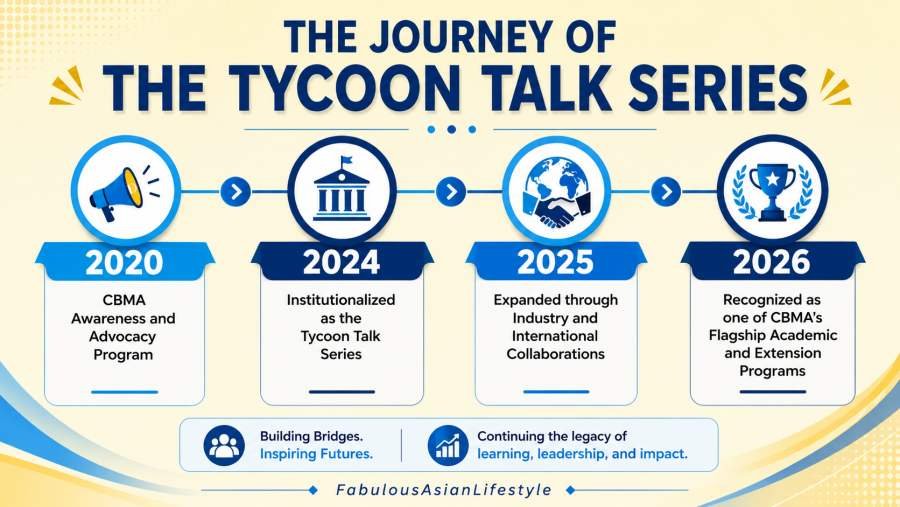
THE JOURNEY OF THE TYCOON TALK SERIES
When an Idea Met a Crisis
Great institutions are rarely built overnight.
More often than not, they begin with a simple question asked during a difficult time.
For the College of Business Management and Accountancy (CBMA) of STI West Negros University, that defining moment came during the COVID-19 pandemic—a period that disrupted education across the globe and challenged universities to rethink how meaningful learning could continue when classrooms suddenly fell silent.
Face-to-face lectures were suspended. Academic conferences disappeared from calendars. Community extension programs and industry engagements, long regarded as essential components of business education, came to an abrupt halt. Like many educational institutions, the University faced the daunting task of maintaining academic excellence while adapting to an entirely new learning environment.
For many schools, survival meant moving classes online.
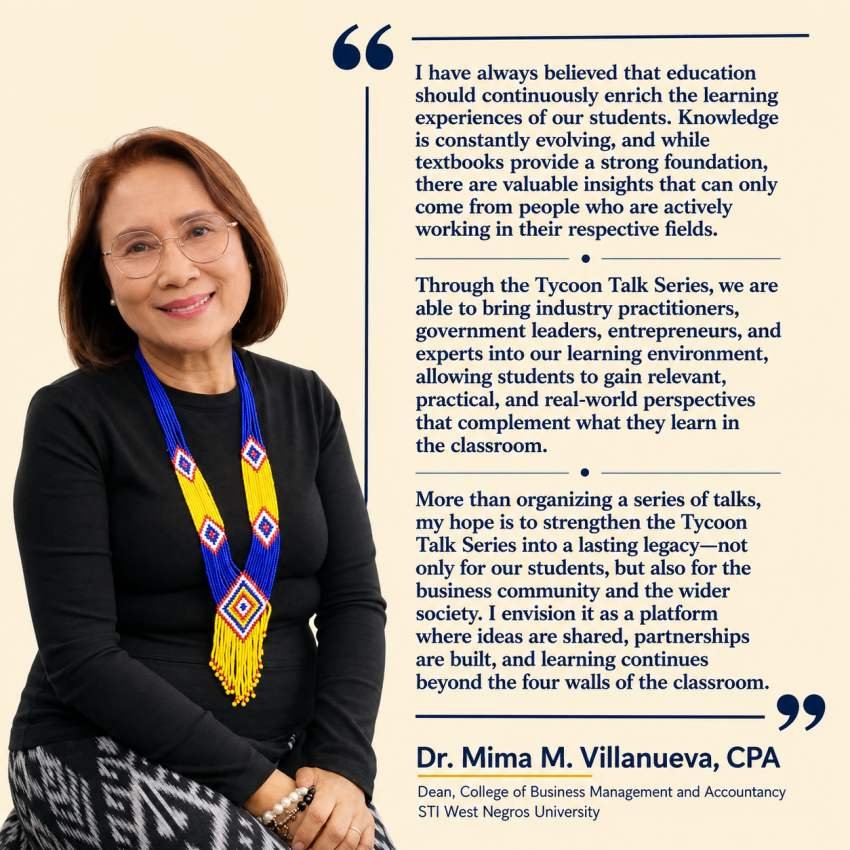
For Dr. Mima M. Villanueva, CPA, Dean of the College of Business Management and Accountancy, the challenge went much deeper.
Business education, she believed, should never be confined to textbooks alone. Students learn best when theories are reinforced by people who have experienced the realities of managing organizations, building businesses, crafting public policies, and solving everyday challenges in their respective professions.
The question then became:
How could students continue learning from practitioners when the world itself had come to a standstill?
Rather than looking outside the University for answers, Dean Villanueva looked within.
Among the College’s graduate students were seasoned professionals—entrepreneurs, government executives, accountants, public administrators, healthcare practitioners, development workers, and business leaders. While they attended graduate school to advance their own education, they also carried with them years of professional experience that could benefit younger learners.
It was an untapped resource hiding in plain sight.
Instead of inviting outside speakers, why not allow these professionals to share their knowledge with senior high school and college students?
That simple yet visionary idea became the foundation of what was then known as the CBMA Awareness and Advocacy Program.
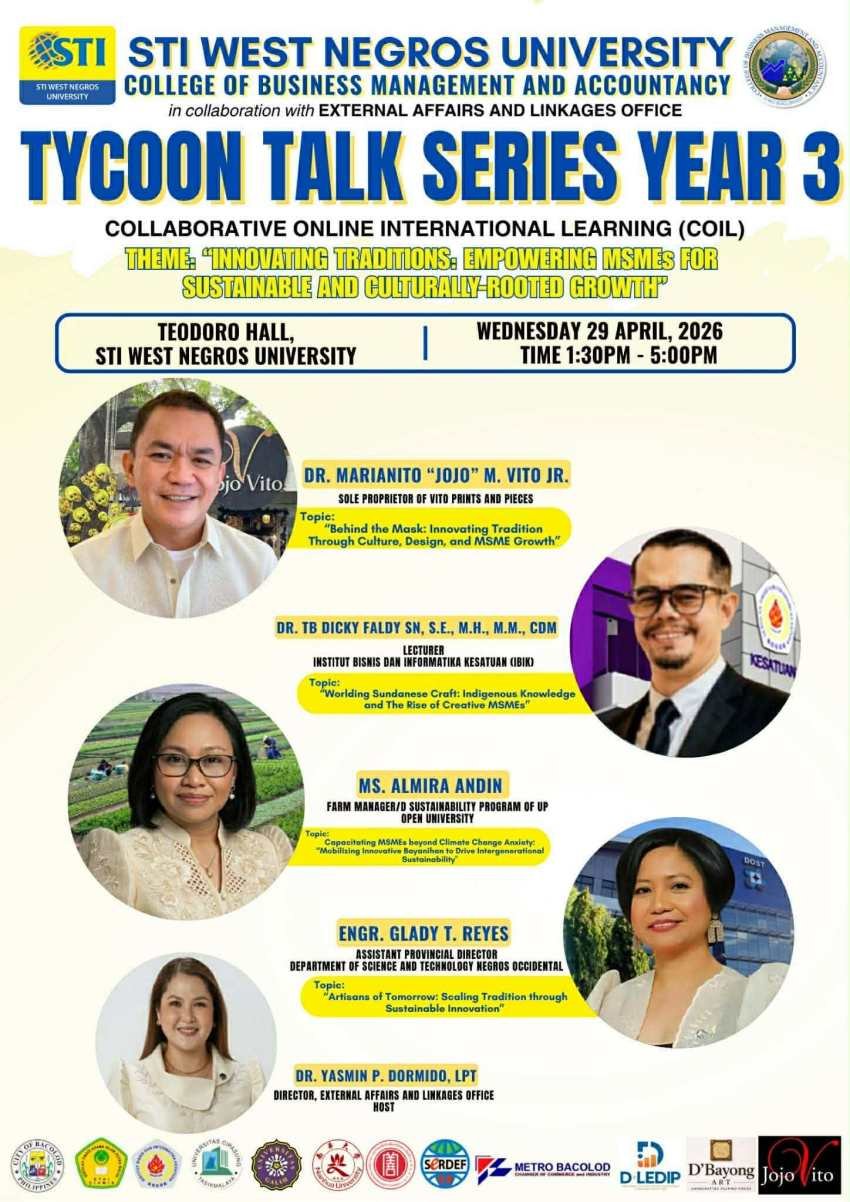
In 2024, Dean Mima M. Villanueva invited Dr. Yasmin Pascual Dormido to become part of the Tycoon Talk Series. At the time, Dr. Dormido was teaching in the University’s Master in Public Administration (MPAD) and Doctor in Public Administration (DPAD) programs. Dean Villanueva recognized that Dr. Dormido’s background as a former ABS-CBN broadcast journalist could add a unique dimension to the program.
It was Dean Villanueva who proposed adopting a television talk show format instead of the conventional lecture style. She believed that a conversational setting would make the sessions more engaging, encourage interaction, and allow students to connect more naturally with accomplished entrepreneurs, executives, and public leaders.
With her extensive broadcasting experience, Dr. Dormido brought this vision to life. Serving as host and moderator, she skillfully facilitated discussions, guided conversations, and created a relaxed yet professional atmosphere that encouraged speakers to share authentic stories and students to participate actively. Her communication expertise transformed each session into an engaging dialogue rather than a one-way lecture, making every conversation more dynamic, memorable, and meaningful.
While the concept and educational vision remained those of Dean Villanueva, Dr. Dormido’s on-camera experience and moderation skills gave the Tycoon Talk Series its distinctive identity and polished presentation style. Together, they created a learning environment where academic concepts were enriched by real-world experiences and genuine conversations.
When the Classroom Opened to the World
Many worthwhile initiatives begin with good intentions.
Only a few evolve into institutions.
For the College of Business Management and Accountancy, the success of the CBMA Awareness and Advocacy Program raised an important question.
What if this initiative could continue long after the pandemic?
The answer was clear.
Rather than allowing the program to end as campuses gradually reopened, the College made a bold decision—to institutionalize it as the Tycoon Talk Series in April 2024.
It was more than a change of name.
It represented a new educational philosophy.
Instead of limiting learning to professors and textbooks, the Tycoon Talk Series sought to bring the outside world into the classroom. Students would not only learn from educators but also from the very people shaping industries, crafting public policies, building businesses, and transforming communities.
The classroom had become a meeting place where ideas from the academe intersected with real-world experience.
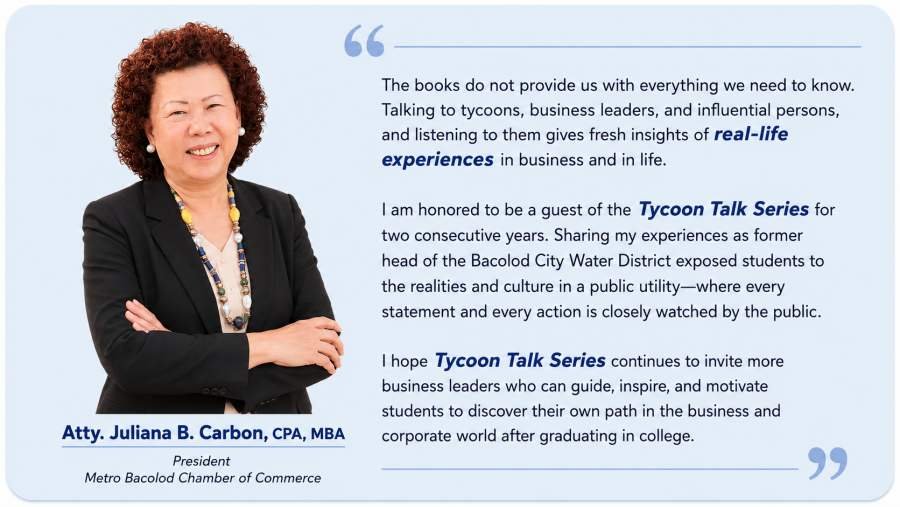
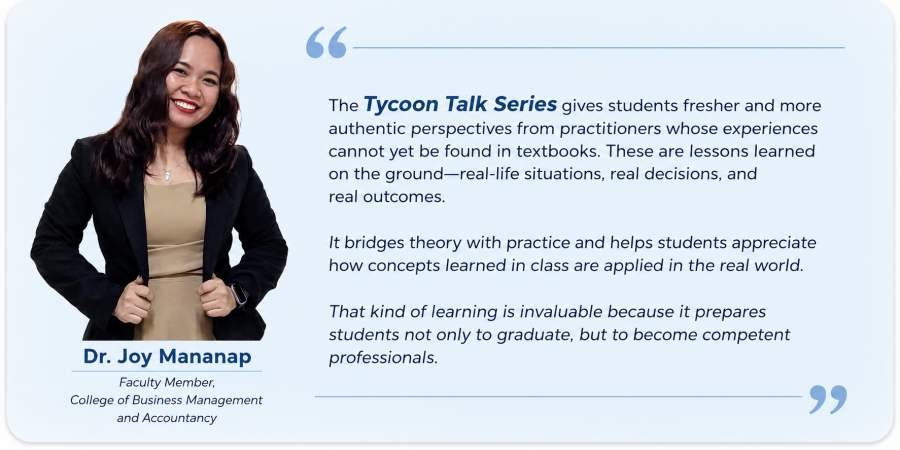
Learning Beyond the Textbook
As the program matured, its network of speakers expanded significantly.
Business executives shared the realities of managing organizations in an increasingly competitive economy.
Entrepreneurs discussed the challenges of starting and sustaining enterprises.
Government officials explained how policies influence businesses, communities, and economic development.
Representatives from professional organizations, national government agencies, local government units, and development institutions offered perspectives on governance, taxation, entrepreneurship, financial management, sustainability, innovation, digital transformation, and responsible leadership.
Each speaker brought something unique.
More importantly, each speaker brought something students could not find in textbooks.
The conversations became practical.
Relevant.
Current.
Students were no longer simply memorizing concepts—they were understanding how those concepts were applied in boardrooms, government offices, business enterprises, and community organizations.
For faculty members, the Tycoon Talk Series also became a valuable academic resource.
The discussions enriched classroom instruction by exposing both teachers and students to emerging business practices, contemporary issues, and industry trends that continuously reshape the professional landscape.
The result was an educational experience that became increasingly dynamic, collaborative, and responsive to the needs of the modern workplace.
Beyond Borders
While the Tycoon Talk Series, in collaboration with the External Affairs and Linkages Office headed by Dr. Yasmin Pascual Dormido, had already connected students with distinguished leaders from business, government, and the professional sector, Dean Mima Villanueva envisioned taking the program even further.
She believed that preparing globally competitive graduates required more than local exposure. In an increasingly interconnected world, students needed opportunities to learn from diverse perspectives beyond the Philippines.
Technology made that vision a reality.
Through strategic partnerships with higher education institutions in Indonesia, Thailand, and Vietnam, the Tycoon Talk Series welcomed international educators, researchers, entrepreneurs, and industry practitioners who shared valuable insights on entrepreneurship, innovation, sustainability, governance, and business development from a regional ASEAN perspective.
For many participants, these virtual exchanges marked their first opportunity to engage directly with experts from neighbouring countries. Without leaving Bacolod, students gained meaningful exposure to different business ecosystems, cultural contexts, educational practices, and innovative approaches to addressing shared regional challenges.
More importantly, these conversations expanded their worldview. Students discovered that while ASEAN nations may differ in language, culture, and economic conditions, they often face similar opportunities and challenges that can best be addressed through collaboration, innovation, and shared learning.
Anchored on the United Nations Sustainable Development Goals (SDGs), each session challenged participants to look beyond financial success and examine how entrepreneurship, responsible leadership, environmental stewardship, and social innovation can work together to create resilient and sustainable communities.
What began as a lecture series evolved into something far more significant.
The Tycoon Talk Series became a gateway to global learning—a platform where classrooms transcended borders, ideas crossed cultures, and students discovered that the future of leadership is built not only on knowledge but also on international collaboration and a shared commitment to making a positive impact on the world.
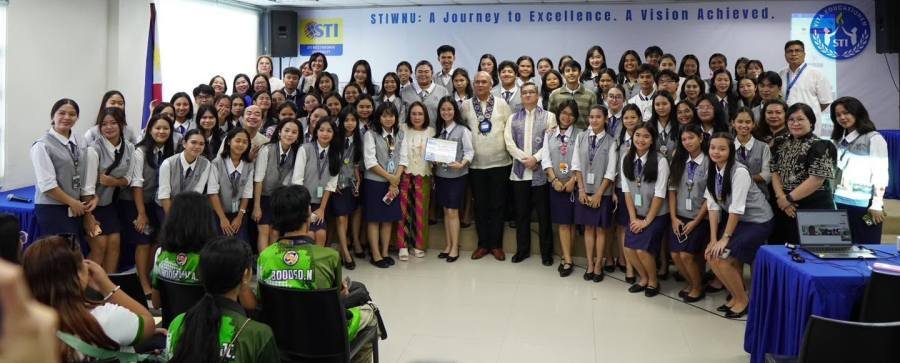
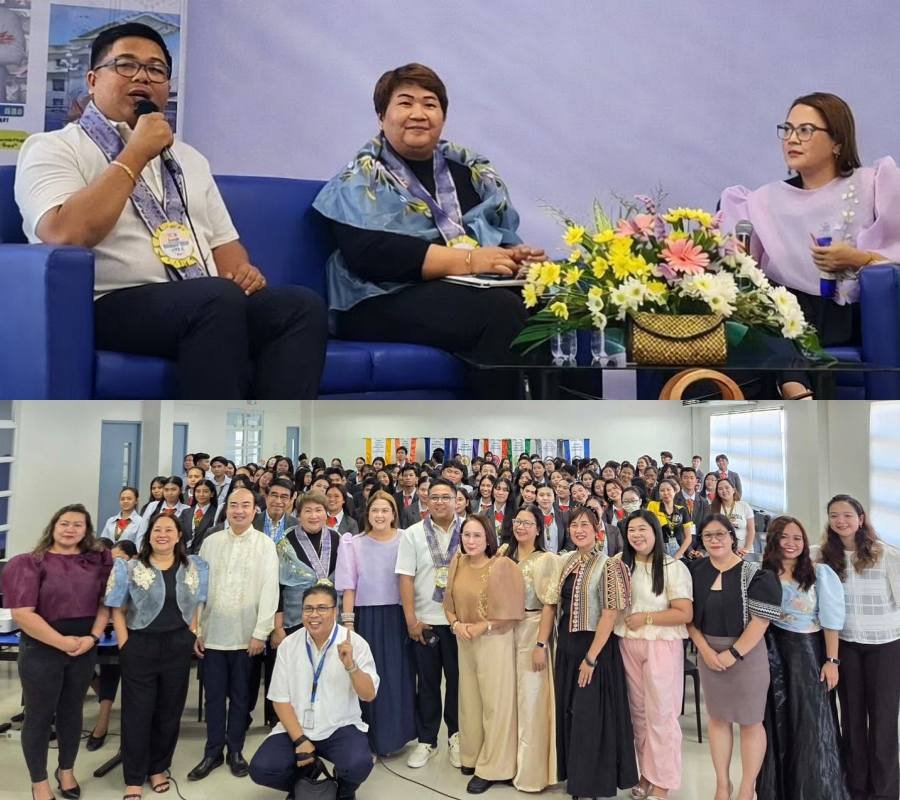
Leading the discussion was Prof. Melchor C. Morandarte, President of the Small Enterprises Research and Development Foundation, Inc. (SERDEF) (center, in barong). Joining him were Dr. Frederick C. Berroya, Vice President for Academic Affairs of STI West Negros University (also in barong), and Dean Mima Villanueva (in Filipiniana attire), underscoring the university’s commitment to academic excellence and global collaboration.
—————————————–
Creating a Community of Learners
Perhaps the program’s greatest achievement lies not in the number of speakers it has hosted but in the community it has created.
Within every Tycoon Talk session are people representing different sectors of society.
Business leaders.
Entrepreneurs.
Government officials.
Faculty members.
Students.
International educators.
Professional organizations.
Each brings a different perspective.
Each contributes to a richer conversation.
Together, they form an ecosystem where learning flows in every direction.
Students gain practical insights.
Industry develops stronger connections with future professionals.
Faculty members remain current with emerging practices.
Partner organizations contribute to the University’s educational mission while strengthening their own engagement with the community.
The result is a partnership that benefits everyone involved.
That, perhaps, is the true strength of the Tycoon Talk Series.
It does not simply invite speakers to campus.
It builds relationships.
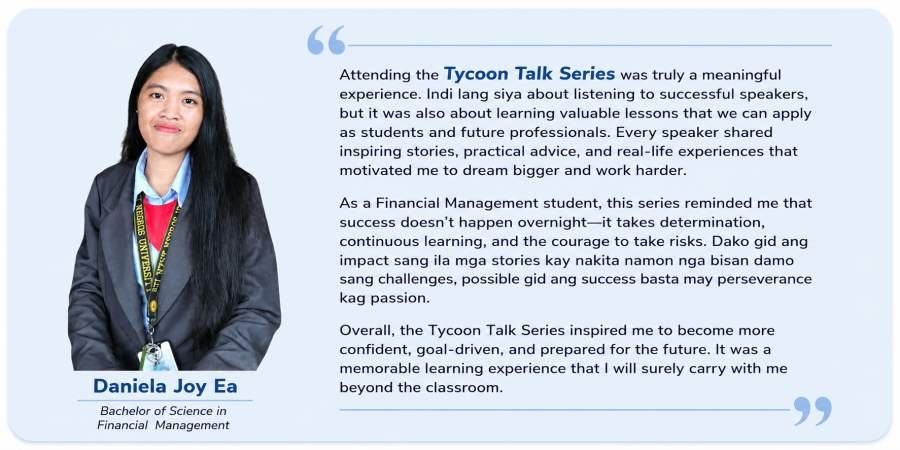
Building an Institution, Not Just an Event
Educational programs are often remembered for the number of seminars they organize or the distinguished personalities they invite. Truly meaningful initiatives, however, are remembered for something far more lasting—the opportunities they create and the people they inspire.
The Tycoon Talk Series has reached that point.
What began as a creative response to the challenges of the COVID-19 pandemic has evolved into one of the College of Business Management and Accountancy’s defining academic and extension programs. More importantly, it has become a platform where education extends beyond classroom instruction by connecting students with leaders from business, government, professional organizations, and the international academic community.
Its strength is not measured by attendance alone.
It is measured by the quality of conversations it creates, the partnerships it nurtures, and the learning experiences it continues to provide.
Students gain firsthand insights from practitioners.
Faculty members remain connected to current industry practices.
Business leaders and entrepreneurs help shape future professionals.
Government agencies strengthen public awareness through meaningful dialogue.
International partners broaden students’ perspectives by sharing experiences beyond Philippine borders.
Together, these relationships have transformed the Tycoon Talk Series into a learning ecosystem where knowledge flows in every direction.
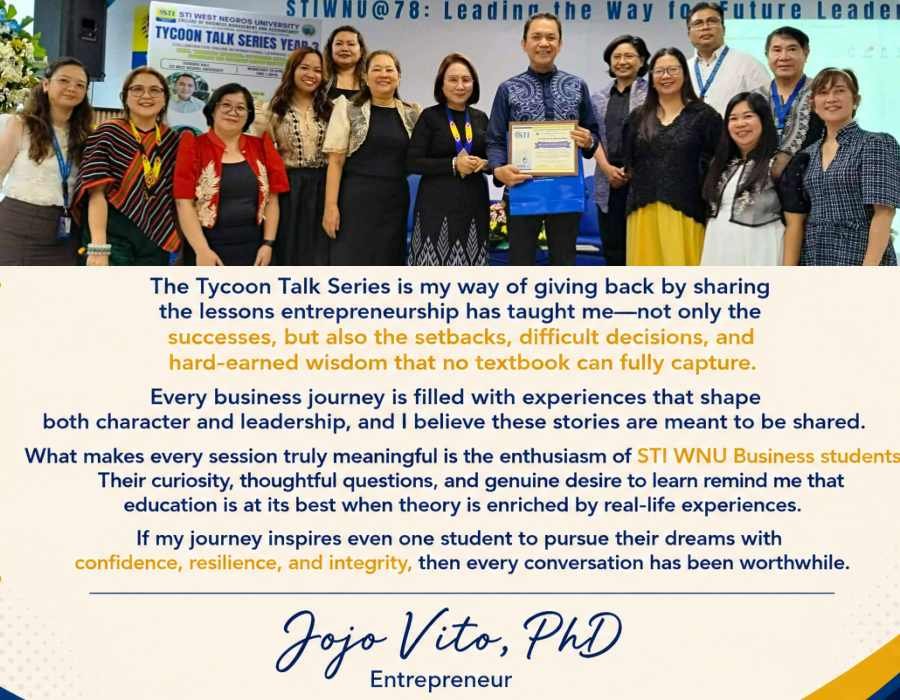
From Conversations to Experiences
The influence of the Tycoon Talk Series eventually inspired another flagship initiative of the College—the Tycoon Business Week.
While the Tycoon Talk Series introduces students to contemporary ideas, leadership perspectives, and industry realities, Tycoon Business Week provides opportunities to apply those lessons through entrepreneurial exhibits, business competitions, industry immersion, product development, and marketing activities.
Together, these flagship programs reinforce a common educational philosophy:
Learning becomes more meaningful when ideas are transformed into action.
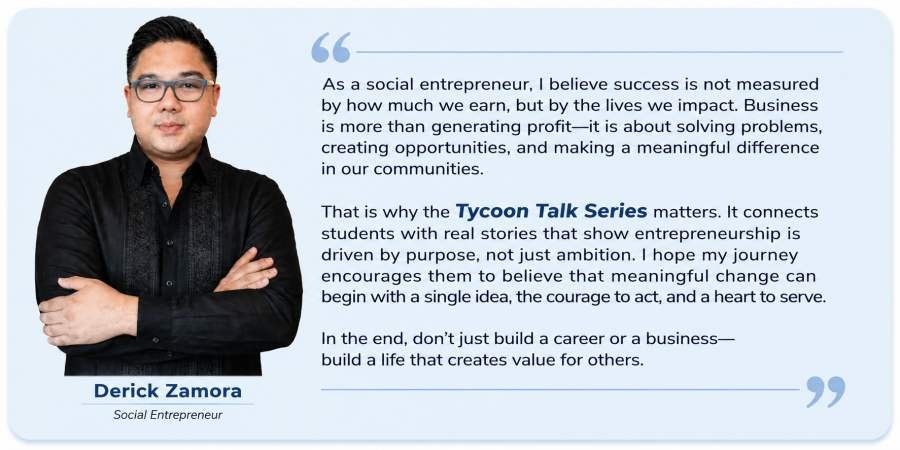
More Than a Series of Talks
Perhaps the true success of the Tycoon Talk Series cannot be measured by the number of speakers it has welcomed or the sessions it has conducted over the years.
Its real impact is reflected in the students who leave each session with broader perspectives and renewed confidence.
It is reflected in faculty members who continue to enrich classroom discussions through insights shared by practitioners.
It is reflected in entrepreneurs, executives, public servants, and international educators who willingly invest their time to help shape the next generation of professionals.
Above all, it is reflected in a University that understands education should never exist in isolation.
The classroom should not be separated from industry.
Business should not be disconnected from society.
Learning should not end at graduation.
These principles continue to define the Tycoon Talk Series today.
From a modest online initiative during one of the most challenging periods in modern education, it has grown into one of STI West Negros University’s most meaningful academic platforms—one that continues to connect ideas, people, and opportunities across industries, institutions, and even national borders.
Its continuing success demonstrates that meaningful education is built not only on curriculum and instruction, but also on collaboration, curiosity, and a shared commitment to preparing students for an ever-changing world.
That may well be the Tycoon Talk Series’ greatest contribution.
Not simply that it organizes lectures—
but that it has built a lasting bridge between the classroom and the real world.












Congratulations Dr. Mima. We are lucky to have you as one of our professors. You truly inspires us to do more and serve more. God bless you always Doc.
I enrolled in the STI Master’s in Business Administration course out of necessity for my further growth not just as a health practitioneer but to become an entrepreneur in my own way. A person without any knowledge of how to conduct business, I was very hesitant at first to pursue this graduate course. I would never forget our first meeting in the college, it was at Brgy. Taculing social event for the project of the barangay for pensioners. I listened to the report, a research by one of the graduate students. It was an eye-opening experience for me, this college values learning outside the 4 corners of the classroom. After learning that program as such was conceptualize pandemic times, I’m glad to be a part of this college. Dr Mima Villanueva’s vision is not easy to materialize without the faculty’s unending support for the program. Success is for those who value growth and learn that growth is dynamic, to challenge the norm is how we evolve our understanding of society and how business is transacted and carried out.
You are truly an inspiration Doc Mima. ❤️ Thank you for sharing your incredible Journey ❤️❤️❤️ Powerful Woman ❤️
It is an inspiring and insightful account of visionary leadership, perseverance, and institutional development. It effectively highlights how a simple idea, when supported by clear purpose, determination, and commitment to excellence, can grow into a lasting institution that creates meaningful impact. Doc Mima’s journey demonstrates that true leadership goes beyond achieving personal success—it involves empowering others, nurturing opportunities, and building a legacy that benefits the community and future generations. The masterpiece is a valuable reminder that sustainable institutions are built through courage, passion, innovation, and unwavering dedication to a greater vision.
I started my teaching stint in 2005. Doc Mima was my Dean for 5 years while I taught Accounting and Finance to BSA students, many of whom have become CPAs. I have gone back to full time since middle of 2025, under the wings again of Doc Mima. Wala pa rin siyang kupas. Still a great academe leader. Still oozing with creativity and innovation. She is akin to a fine wine. Getting much better as she age.
Congratulations, Doc Mima! Your vision, passion, and dedication to education are truly inspiring. Thank you for creating opportunities that connect students with real-world knowledge and for building a legacy that will continue to empower future generations. Your leadership is making a lasting difference, and we are proud to witness the impact of your work. Wishing you continued success, good health, and God’s abundant blessings always!
Congratulations, Doc Mima! Your brilliance and dedication serve as a shining example for all of us. As an educator, your accomplishment encourages me to continue inspiring others with renewed purpose and passion. Thank you for demonstrating the profound impact that commitment and excellence can have on our community.
Very Encouraging and Educational.
Congratulations Doc Mima Villanueva on completing a truly successful talk series! Your hard work and clear vision brought people together and made a lasting impact.
Congratulations Doc Mima Villanueva on completing a truly successful talk series! Your hard work, great topics, and clear vision brought people together and made a lasting impact.
Congratulations, Doc Mima Villanueva. for your dedication, your passion, and your unwavering commitment to lifting up every student you serve have made a lasting mark on this institution and on all of us. We are all better, more prepared, and more inspired because of you. God bless you always.
Warmest congratulations, Doc Mima! Your vision, dedication, and transformational leadership continue to make a lasting impact. Wishing you even greater success as you continue to inspire and empower those around you!
This is a perfect example of what transformational leadership truly means. Instead of simply keeping the school running or just handling day-to-day operations during the difficult pandemic period, she took things much further. She completely redesigned and rebuilt how the whole school system works, by trusting and giving more power and responsibility to everyone who is part of the school community. This practical approach clearly shows an important truth: education is something that we all build together as a team. It is never just a service that teachers and staff provide to students alone. Congratulations!!
Congratulations, Doc Mima Villanueva! Your hard work, dedication, and passion are truly inspiring. Your achievements are a reflection of your perseverance and commitment to excellence. May you continue to inspire many people, and may God bless you with good health, wisdom, and more success in the years ahead. Congratulations once again!
Congratulations,Doc Mima Villanueva, your hardworking and dedication is the key to success. May you continue to inspire each one of us and may God bless you always.
Congratulations, Dr. Mima! Your story of turning a simple idea into a lasting institution is truly inspiring. Thank you for your vision, dedication, and commitment to shaping the future through education. Wishing you continued success and many more milestones. God bless you always!
Heartfelt congratulations, Dr. Mima Villanueva. Your dedication to bringing industry leaders and real-world insights into the classroom has made such a meaningful impact. The Tycoon Talk Series is proof that one person’s vision can create lasting change. May you continue to lead with excellence!
Congratulations, Dr. Mima Villanueva! Your hard work and commitment are truly admirable. May you continue to inspire and empower others.
This is a perfect example of what transformational leadership truly means. Instead of simply keeping the school running or just handling day-to-day operations during the difficult pandemic period, she took things much further. She completely redesigned and rebuilt how the whole school system works, by trusting and giving more power and responsibility to everyone who is part of the school community. This practical approach clearly shows an important truth: education is something that we all build together as a team. It is never just a service that teachers and staff provide to students alone.
Congratulations Dr. Mima Villanueva
Instead of limiting learning to professors and textbooks, the Tycoon Talk Series sought to bring the outside world into the classroom. Students would not only learn from educators but also from the very people shaping industries, crafting public policies, building businesses, and transforming communities. More success to come.
Dean Mima M. Villanueva transformed a challenge into an enduring legacy. What began as an innovative response to the pandemic has grown into the Tycoon Talk Series—a lasting institution that bridges the classroom with industry, government, and the global community. Her vision of experiential, collaborative, and globally connected learning continues to inspire students, empower educators, and strengthen partnerships that prepare future leaders for an ever-changing world. This is a remarkable example of visionary leadership turning a simple ideainto a sustainable academic institution.
A great example of how one idea can make a lasting impact. Thank you, Dean Mima Villanueva, for creating the Tycoon Talk Series and giving students valuable learning experiences beyond the classroom
Congratulations. Dr. Mima Villanueva on your inspiring leadership, we have a meaningful opportunity for learning through the tycoon talk series. Wishing you more success
Congratulations our Dean Doc. Mima, Your vision bridged the gap between theory and real practice, giving me insights and confidence no textbook could ever provide. We are truly grateful for your heart and dedication to shaping future business leaders like me.
Congratulations our Dean Doc Mima, Your vision bridged the gap between theory and real practice, giving me insights and confidence no textbook could ever provide. We are truly grateful for your heart and dedication to shaping future business leaders like me.
As a Bachelor of Science in Business Administration student Majoring in Marketing Management, I, Prince Carl Brian R. Henson, can honestly say I would not have gained such clear, real-world perspective anywhere else.
I’ve learned that marketing isn’t just about selling products or making catchy advertisements. It’s about understanding people their needs, their fears, and what truly matters to them. It’s about being agile enough to pivot when plans fall apart, ethical enough to stand by your values even when facing pressure, and humble enough to keep learning no matter how much experience you already have.
Beyond the lessons, Tycoon Talk gave me the confidence that I too can make it in this field. Seeing successful professionals who once sat exactly where I am now, who faced the same doubts and overcame the same struggles, showed me that my goals are within reach. It bridged the gap between the classroom and the corporate world, turning abstract ideas into a clear path forward for my own career.
What started as a way to keep learning alive when our world paused has become a gift that keeps giving one story, one lesson, and one spark of inspiration at a time. And I am so grateful to be part of this legacy that proves the best teachers are often right beside us.
Congratulations, Dr. Mima Villanueva, on your inspiring leadership and dedication. Your vision turned a difficult time into a meaningful opportunity for learning through the Tycoon Talk Series. Wishing you continued success!
Truly an inspiring story of women empowerment worthy of recognition and admiration. Congratulations Dr. Mima Villanueva. Wishing you and your programs, continued success and many more milestones ahead!
You are amazing, Doc Mima! I truly admire your dedication to bridging the gap between learning and the circumstances that hinders its delivery to students. Today, STIWNU is recognized for producing excellent learners who continue to develop their education and who are eager to pursue further studies, made possible by its flexible programs. Kudos!
Congratulations, Dr. Mima Villanueva, for your exceptional vision and leadership in transforming a pandemic challenge into a flourishing, globally connected academic institution with the Tycoon Talk Series!
Your inspiring leadership, Dean Mima, motivates academic excellence, purposeful service, and continuous growth for all educators and students.
Throughout the Tycoon Talk Series, I learned the importance of discipline, networking, and having a clear vision. The speakers showed me that success isn’t overnight , it’s built daily.
An inspiring testament to visionary leadership and dedication. Congratulations, Dean Mima Villanueva, for turning an idea into a lasting institution that continues to inspire and empower future entrepreneurs. Truly a legacy worth celebrating!
Congratulations, Dr. Mima Villanueva, on your inspiring leadership and unwavering dedication. Your vision has transformed challenging circumstances into a meaningful avenue for learning and growth through the Tycoon Talk Series. May you continue to achieve great success in all your endeavors!
WOW… what an empowered woman… ikaw na Doc Mima…
Congratulations, Dr. Mima Villanueva! Your hard work and commitment are truly admirable. May you continue to inspire and empower others. Your vision turned a difficult time into a meaningful opportunity for learning through the tycoon talk series. Wishing you continued success!
What an inspiring story of vision, innovation, and resilience! The Tycoon Talk Series is a testament to how challenges can become opportunities for meaningful learning. Congratulations to everyone who made this remarkable initiative possible!
An inspiring read! Dean Mima Villanueva’s journey is a powerful reminder that lasting institutions are built on vision, resilience, and a genuine commitment to serving others. Success isn’t just about having a great idea, but about consistently nurturing it with purpose and integrity. Thank you for sharing such a meaningful story that motivates aspiring entrepreneurs, educators, and leaders alike.