
Table of Contents
Why Resilient Power Supply Agreements Matter: Primelectric Joins the Energy Conversation at PHILRECA 2026
Electricity is one of those things people often take for granted until the lights go out or the monthly bill becomes difficult to manage. Yet behind every reliable power connection is a complex system of decisions, contracts, investments, and partnerships that determine how electricity reaches homes, businesses, and communities.
This is precisely why discussions about Power Supply Agreements (PSAs) deserve attention, particularly at a time when the Philippine energy sector continues to face uncertainties in electricity prices, generation costs, and supply reliability.
These concerns took center stage at the recent Philippine Rural Electric Cooperatives Association (PHILRECA) 2026 event held at the Waterfront Cebu Hotel, where industry leaders and stakeholders gathered to discuss issues affecting the country’s power sector.
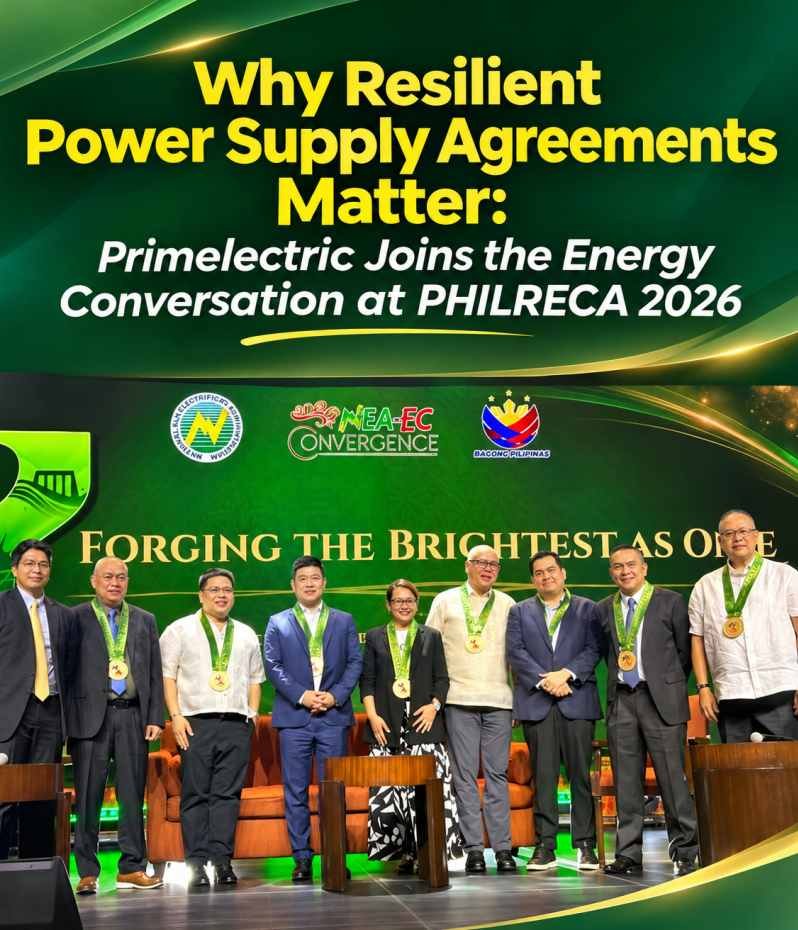
Among the industry representatives was Atty. Richard Nethercott, Chief Operating Officer of Primelectric Holdings Inc. (PHI), who participated as a panelist in the PHILRECA Fireside Chat titled “Powering Through the Storm: Resilience of Power Supply Agreements in an Unpredictable Energy Market.”
His participation brought attention to an important aspect of the electricity business that consumers may not always see but which has a direct bearing on the quality, reliability, and cost of the power they receive.

Beyond Contracts: The Strategic Importance of Power Supply Agreements
Power Supply Agreements are more than commercial documents between electricity suppliers and distribution utilities. They are strategic instruments that help determine how power requirements are secured, how costs are managed, and how risks are shared between contracting parties.
These agreements establish important terms, including electricity pricing, contracted capacity, supply volume, and contract duration. They are entered into by power suppliers and distribution utilities, including electric cooperatives, to provide a framework for electricity procurement.
During the Fireside Chat, Atty. Nethercott emphasized the importance of PSAs in promoting energy security, price stability, and supply reliability, particularly in an increasingly unpredictable energy market.
I believe this is an important point that deserves greater public attention.
When consumers discuss electricity, the conversation often revolves around the amount they pay per kilowatt-hour. Understandably, the price matters. However, the circumstances behind that price are equally important. How does a distribution utility secure its electricity requirements? How exposed is it to sudden changes in market prices? What happens when supply becomes constrained?
These are not merely technical questions. They are fundamental considerations in protecting consumers and maintaining economic activity.
A properly structured PSA can help distribution utilities manage these uncertainties and provide greater predictability in their power procurement costs. While no contract can completely eliminate market risks, sound contractual arrangements can help reduce exposure and establish a more stable foundation for electricity supply.
The Challenge of an Unpredictable Energy Market
The Philippine electricity industry operates in an environment influenced by several interconnected factors. Changes in fuel prices, fluctuations in electricity market rates, power plant outages, and supply constraints can affect both the availability and cost of electricity.
For distribution utilities, these developments make power procurement a continuing strategic challenge.
Securing electricity is not simply about finding the cheapest available supplier. It also involves evaluating the supplier’s capacity, the reliability of its generation resources, the commercial terms of the agreement, and the potential risks that may arise throughout the contract period.
This is where the resilience of PSAs becomes particularly relevant.
A contract that looks attractive because of its initial pricing may not necessarily provide the best long-term value if its provisions leave the distribution utility excessively exposed to market uncertainties.
In my view, the real measure of a good power supply agreement should not be based on price alone. It should also consider how well the agreement protects the distribution utility and, ultimately, its consumers when market conditions become unfavorable.
The objective should be to secure a supply arrangement that remains commercially reasonable and operationally dependable even when the energy market encounters difficulties.
The Consumer Must Remain at the Center of Energy Decisions
At the end of the day, discussions about energy procurement should always lead back to the consumer.
For households, electricity is an essential part of daily living. For businesses, it is an operating necessity. For industries, it is a critical input that influences production costs, competitiveness, and investment decisions.
When electricity becomes more expensive or unreliable, the effects extend beyond monthly household budgets. Businesses may face higher operating expenses, entrepreneurs may struggle with increasing costs, and industries may find it more difficult to remain competitive.
This is why affordability and reliability must go hand in hand.
A distribution utility must consider not only how to obtain electricity at a competitive price but also how to maintain dependable service over time. These two objectives should not be treated as competing priorities. They must be considered together when making power procurement decisions.
Atty. Nethercott’s emphasis on resilient and well-structured PSAs highlights this balancing act. Such agreements can help electric cooperatives navigate uncertainties while maintaining attention to affordability, reliability, and long-term energy security.
I would add that consumers should also be encouraged to understand the bigger picture behind electricity pricing. Not every increase or fluctuation can be attributed to the distribution utility alone. Generation costs and other factors in the electricity supply chain also influence the final cost of power.
Greater public understanding of these interconnected factors can contribute to more informed discussions about electricity rates and the responsibilities of the different players in the energy sector.
Collaboration Is Essential to a Stronger Power Industry
Another important takeaway from PHILRECA 2026 is the value of bringing industry stakeholders together.
The electricity sector cannot operate effectively through isolated decisions. Power generators, distribution utilities, electric cooperatives, regulators, and other stakeholders are part of an interconnected system. What happens in one segment can have consequences for the others.
Events such as PHILRECA provide an avenue for these stakeholders to exchange ideas, discuss emerging challenges, and explore ways to improve the industry’s capacity to respond to market uncertainties.
Primelectric Holdings Inc.’s participation in the Fireside Chat demonstrates its engagement in these important industry conversations.
I consider this kind of participation valuable because the challenges confronting the power sector require more than individual corporate solutions. They require dialogue, coordination, and a shared understanding of the industry’s long-term needs.
The more effectively industry players work together, the greater the opportunity to develop practical approaches to supply security, cost management, and service reliability.
Primelectric’s Presence in the Philippine Electricity Distribution Sector
Primelectric Holdings Inc. is the holding company of three electricity distribution companies: More Electric and Power Corporation (MORE Power), Negros Electric and Power Corporation (Negros Power), and Bohol Light Company, Inc. (Bohol Light).
Through these companies, Primelectric has established its presence in different areas of the country, making its participation in industry discussions particularly relevant to the broader electricity distribution landscape.
Its involvement in PHILRECA 2026, through its Chief Operating Officer, reflects the importance of engaging with other stakeholders on matters that affect the industry’s future.
The discussion on Power Supply Agreements also reinforces the need for distribution utilities to adopt a forward-looking approach to electricity procurement. Market conditions will continue to change, and the ability to anticipate and manage these changes will remain an important consideration in sustaining reliable electricity service.
Looking Beyond Today’s Electricity Rates
The Philippine power sector faces a continuing challenge: how to provide electricity that is affordable, reliable, and sustainable in an environment where uncertainty has become part of the business.
There is no single solution to this challenge. Infrastructure investments, efficient distribution systems, responsible power procurement, sound regulatory policies, and effective industry partnerships all have important roles to play.
However, the importance of resilient Power Supply Agreements should not be underestimated.
As highlighted by Atty. Richard Nethercott during the PHILRECA 2026 Fireside Chat, these agreements can serve as important mechanisms for managing market risks and strengthening energy security.
My takeaway is simple:
The true value of a power supply agreement is not measured solely by the price of electricity it secures today, but also by the protection, stability, and reliability it can provide when tomorrow’s energy market becomes uncertain.
For consumers, this means having a power industry that looks beyond immediate concerns and makes decisions with long-term consequences in mind.
For industry stakeholders, it means recognizing that energy security is a shared responsibility.
And for companies such as Primelectric Holdings Inc., participating in conversations that address these concerns is an important part of contributing to a more resilient Philippine power sector.
More Stories
- Bakawan Award: Negros Power Receives First Gen’s Highest Corporate Honor
- Negros Power Energizes Four More Sitios in Talisay City
- Primelectric CEO Roel Castro on Power System Resilience
- Negros Power Undas 2026: Cemetery Response Teams in Bacolod
- Negros Power October 2026 Rate Increase: What It Means for Consumers and Businesses
- Retirement in the Philippines: Poor by Choice? Stop Judging!
- Asdes Gonzaga Transformer Replacement: What It Means for Bacolod Consumers
- Panda Plates | Bacolod’s Smiles Come With a Side of Flavor
- foodpanda CRAVE Awards 2026 | Bacolod Food Brands Shine
- GStocks PH Users Get Real-Time Allocation in Mynt IPO Starting at 100 Shares
- Offcourt Pickleball Bacolod Opens | Why I’m Suddenly Curious
- Happy Teachers Day: Those Who Stayed, Struggled, Still Showed Up