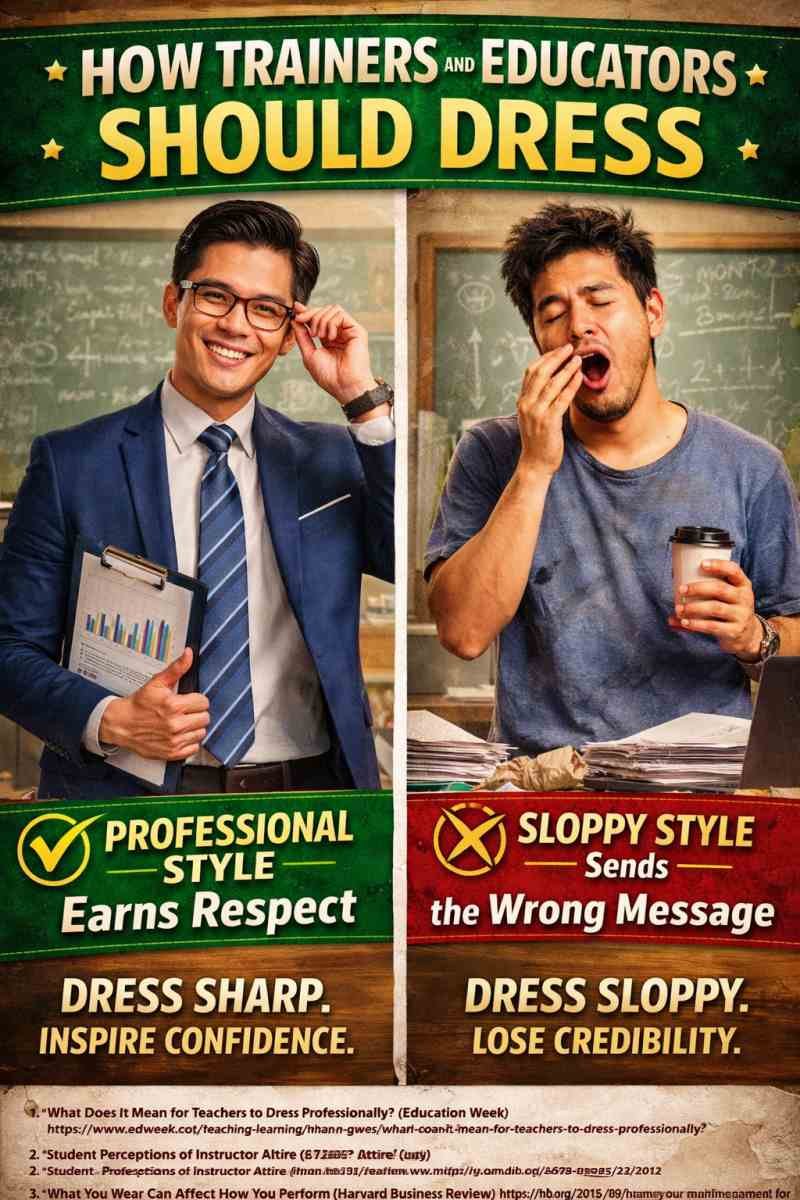
How Trainers and Educators Should Dress
Table of Contents
How Trainers and Educators Should Dress: Professional Logic, Principles, Non-Negotiable NO-NOs, Minimum Standards, and Personal Choice
Disclaimer
I am not a fashion expert, nor am I claiming to dress impeccably at all times. This article is not meant to prescribe rigid rules on style or to position myself as an authority on fashion. Rather, it is a personal reflection drawn from years of experience as a trainer and educator, grounded on basic social graces, etiquette, and social decorum. The points shared here are intended to encourage awareness of context, respect for the audience, and professionalism in learning and training environments—not to judge personal taste or individuality in dress.
In education and training, credibility begins long before the first slide appears or the first sentence is spoken. Appearance communicates intention, professionalism, and respect—often silently, but powerfully. For trainers and educators, how one dresses is not about fashion or vanity; it is about presence, responsibility, and purpose.
Introduction
This article serves as a comprehensive reference on how trainers and educators should dress, the logic behind professional attire, the guiding principles, whether dressing up is truly necessary, the clear NO-NOs to avoid, the minimum acceptable standard when dressing down, and a personal reflection shaped by lived professional practice.

Why Dress Matters in Education and Training [ How Trainers and Educators Should Dress ]
Clothing is a form of non-verbal communication. Before a trainer begins teaching, learners have already formed impressions—about competence, credibility, and seriousness. Research consistently shows that educators who dress professionally are often perceived as more knowledgeable, more prepared, and more authoritative.
A study published by MDPI found that instructor attire significantly influences students’ perceptions of professionalism and expertise.
👉 https://www.mdpi.com/2673-9585/2/2/12
Psychology also supports this through the concept of enclothed cognition, which explains how clothing affects confidence, focus, and performance—not just how others see us, but how we see ourselves.
👉 Harvard Business Review: https://hbr.org/2015/04/what-you-wear-can-affect-how-you-perform
In short, what educators wear shapes both the learning climate and their own mindset.

Core Principles Behind Professional Dress
Professional attire in education is guided by several enduring principles:
- 1. Professionalism Over Personal Expression. Education is a service profession. Clothing should support learning, not distract from it.
- 2. Authority With Approachability. Well-chosen attire communicates leadership while remaining inviting and respectful.
- 3. Respect for Learners and Institutions. Dressing well signals respect—for students, colleagues, and the discipline being taught.
- 4. Context Awareness. Different teaching and training environments require different levels of formality, but professionalism remains constant.
- 5. Intentionality. Professional dress is not about excess—it is about making deliberate choices aligned with purpose and audience.

How Trainers and Educators Should Dress or Is It Really Necessary?
It is important to acknowledge that not everyone agrees on the necessity of dressing up in education and training. Some believe that competence, expertise, and teaching ability matter far more than clothing—and that argument has merit.
This article is not written to impose rules or force conformity. Beyond research and policy, professional dress often comes down to personal values and personal choice—how we want to represent ourselves and how we wish to be perceived.
For some, clothing may not matter at all. For others, it does.
For me, it matters.
I am a management consultant who regularly conducts professional training sessions. I also teach in graduate school at both the master’s and doctoral levels. My work takes me across different environments—formal training venues, university classrooms, conference halls, and off-site learning spaces.
There are moments when I conduct sessions outside the classroom, in more relaxed or field-based settings, where I may wear shorts, depending on the location and nature of the activity. There are also many occasions when I am in a full suit, especially when facilitating formal training programs, executive sessions, or professional workshops. Inside the classroom, I often wear a blazer, particularly during lectures, presentations, or doctoral-level discussions.
There are also moments when I dress down—but even then, I make a conscious effort to stay within the bounds of professional dressing.
For me, dressing intentionally is not about impressing others. It is about representing myself, facing people with respect, honoring my craft, and valuing what I teach. It is also a reflection of how I value myself as a professional.

The Non-Negotiable NO-NOs for Educators and Trainers
Regardless of experience, rank, or personal style, the following are widely recognized professional NO-NOs:
❌ Overly Casual Clothing
- Shorts (outside approved fieldwork or activity-based sessions)
- Jogging pants, sweatpants, hoodies
- Flip-flops or slippers
👉 https://climbtheladder.com/what-is-the-dress-code-for-teachers-rules-and-exceptions/
❌ Revealing or Tight Clothing
- Low-cut or off-shoulder tops
- Crop tops or exposed midriff
- Sheer or excessively tight fabrics
These distract and undermine professional presence.
❌ Clothing With Messages or Graphics
- Political slogans
- Profane or suggestive text
- Large logos or novelty graphics
Neutrality helps maintain focus and inclusivity.
❌ Distracting Accessories and Grooming
- Loud or oversized jewelry
- Overpowering fragrances
- Flashy, attention-seeking elements
❌ Poorly Maintained Clothing Wrinkled, stained, torn, or ill-fitting garments
Neatness reflects discipline and respect.
👉 https://sites.google.com/view/teacher-dress-code-guidelines

Dressing Down: The Minimum Acceptable Standard [ How Trainers and Educators Should Dress ]
There are valid occasions where educators and trainers may dress down—community outreach, workshops, or active learning environments. Dressing down, however, should never mean dressing carelessly.
Minimum Professional Standard When Dressing Down:
✅ Clean, pressed, and well-fitted clothing
✅ Modest and non-distracting
✅ More polished than student attire
✅ Appropriate to the activity and audience
Acceptable examples include:
- Polo shirts or plain blouses
- Smart chinos or tailored casual pants
- Dark, clean jeans only if explicitly allowed
- Neat, closed footwear
A simple rule applies: If you would hesitate to wear it in front of a supervisor, client, or administrator, don’t wear it in front of students.

Sneakers with a Suit Jacket: Comfort, Health, and Smart Casual Sense
In today’s smart casual settings, wearing sneakers with a suit jacket has become acceptable for both men and women, particularly in training rooms, classrooms, and workshop venues. This pairing reflects the changing nature of professional environments where educators and trainers are often on their feet for long hours. Sneakers, when styled properly, help create a look that is professional yet approachable, allowing facilitators to connect with their audience without appearing overly rigid.
Comfort and health play a significant role in this choice. Trainers and educators spend entire days standing, walking, and moving between sessions, and supportive footwear can reduce fatigue, strain, and long-term foot or back issues. Choosing well-designed, minimalist sneakers allows both men and women to maintain physical comfort throughout the day while still presenting themselves neatly and appropriately for a learning environment.
As with any smart casual attire, intention and context remain essential. Sneakers should be clean, simple, and appropriate to the overall outfit—paired with a structured suit jacket, tailored trousers, a skirt, or a dress that maintains balance and polish. When done thoughtfully, this combination respects social decorum, acknowledges health considerations, and reflects a modern, practical approach to professional dressing for educators and trainers.

Why This Still Matters Today
Educators are role models. According to ASCD, professionalism in teaching extends beyond instruction—it includes conduct, presence, and appearance.
👉 https://www.ascd.org
What we wear quietly teaches learners about workplace norms, self-respect, and professional identity.
Final Reflection
Professional dress is not about rigidity or enforcing outdated norms. It is about choice, context, and respect. Some may not care—and that is valid. But for many educators and trainers, dressing intentionally is a conscious act: This work matters. The people I face matter. I matter.
Because in education and training, how we show up is part of what we teach.

References (Clickable & Reputable)
- Harvard Business Review – What You Wear Can Affect How You Perform
https://hbr.org/2015/04/what-you-wear-can-affect-how-you-perform - MDPI – Student Perceptions of Instructor Attire
https://www.mdpi.com/2673-9585/2/2/12 - Education Week – What Does It Mean for Teachers to Dress Professionally?
https://www.edweek.org/teaching-learning/what-does-it-mean-for-teachers-to-dress-professionally - Verywell Mind – Enclothed Cognition Explained
https://www.verywellmind.com/enclothed-cognition-definition-4707852 - ASCD – Professionalism in Teaching
https://www.ascd.org - Climb the Ladder – Teacher Dress Code: Rules and Exceptions
https://climbtheladder.com/what-is-the-dress-code-for-teachers-rules-and-exceptions/
More Stories
- Negros Power Lowers Electricity Rates This December 2025
- AI Proofing the Workplace: How to Stay Relevant
- Primelectric Eyes World-Class Power Service
- MACAU TOURIST SPOTS | 20 Attractions You Shouldn’t Miss
- 25 THINGS TO DO IN CAMBODIA | TOURIST SPOTS
- DAVAO TOURIST SPOTS | THINGS TO DO
- THINGS TO DO IN PATTAYA, THAILAND
- Landers Superstore Bacolod | Biggest in the Philippines
- GREEN ENERGY: MORE Power’s Model, Hope for Negros
- Repurposing Your Old Clothes : From Old to Gold
- Power Watch Negros Advocates for Transparent Bill Deposits
- Primelectric Strengthens Korea Partnership to Modernize Philippine Power Grid
- 14th Quan Delicacies Branch Now Open at Ayala Malls Capitol Central